
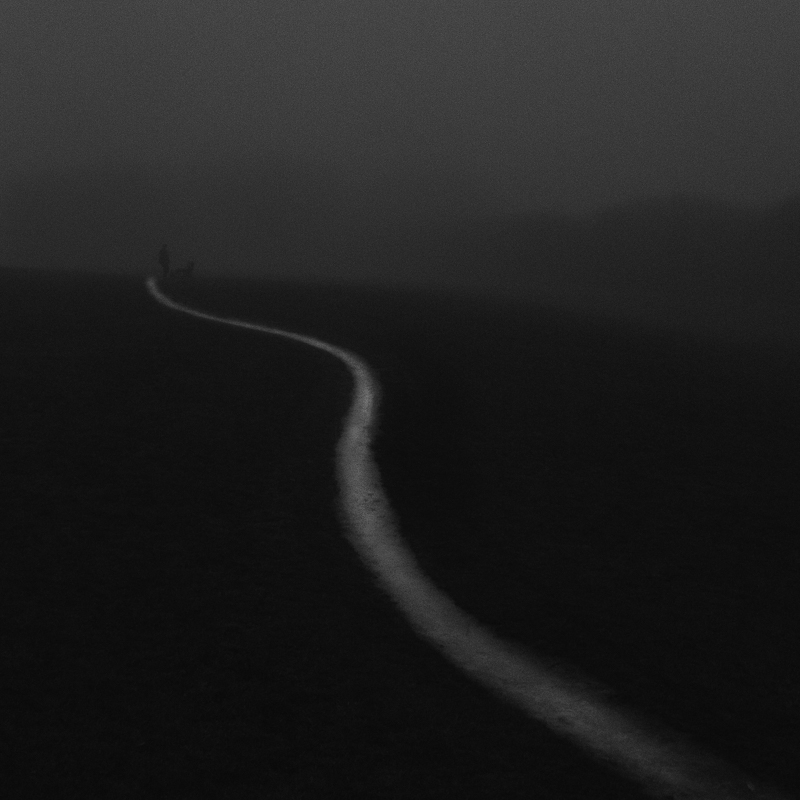
A November Day… in Worksop
This morning I walked Eddie along the lane near the cottage in a thin, persistent mizzle.
May, apparently. The Scots have a wonderful word for such days. ‘Driech’.
North Uist had other ideas. The island had put on its November face: low cloud, wet grass, a pewter sky pressed down over the crofts, the road blackened by rain, the lochans half-erased, the distance withdrawn into itself. Somewhere beyond the fence line, a curlew called. That sound always seems to me less like birdsong than a question carried on cold air. An oystercatcher went over, sharp and indignant, stitching its cry across the grey.
There was no drama. No shaft of light. No grand Hebridean revelation. Just damp, sheep, road, wire, grass, breath, dog, weather.
And yet, because this is North Uist, I know how it can look from elsewhere.
It can look as though inspiration is simply lying about here. Empty beaches. Wild skies. Wind-torn machair. Black water. Bleached shells. Rusted gates. Ruined crofts. The cry of birds over land that still feels older than language. I can imagine someone looking at my life here and thinking, well, of course you can make work there. Of course you can feel moved there. Of course the place gives you images.
And yes, sometimes it does.
But not as simply as that.
A beautiful place does not make the work for us. A remote place does not guarantee depth. Weather is not a substitute for attention. A shoreline can become a cliché in your hands as easily as a shopping precinct. A mountain can be used lazily. A beach can become decorative. A big sky can become a way of avoiding the smaller truth at your feet.
I know this because I have made those mistakes.
I also know what it is to live somewhere that does not appear, on the surface, to offer much at all.
Before North Uist, I lived for more than twenty years in Worksop, an old ex-mining town in the Midlands of England. It was beyond ordinary in the way many English towns are so very ordinary. Brick, road, estate, bypass, park, supermarket, industrial edge, municipal planting, wet pavement, winter trees, tired verges, a particular kind of landlocked greyness. It was not a place people travelled to in search of the sublime. Worksop is blandness personified.
For years I struggled to see it.
That is not quite true. I saw it constantly. I drove through it, walked through it, shopped in it, queued in it, waited at its traffic lights, passed the same walls and corners and patches of grass until they sank beneath recognition. They became facts rather than presences. Named things. Known things. Finished things.
A hedge. A wall. A car park. A road. A field. Nothing.
Habit is a kind of weather. It settles over a place until the place disappears.
We tend to think mist hides the world, but familiarity can be far thicker. At least mist makes us aware that something is hidden. Habit does not. Habit convinces us there is nothing more to see.
This, I think, is where many of us become stuck.
Not because our surroundings are empty, but because we have emptied them by naming them too quickly.
The lane is just the lane. The town is just the town. The garden is just the garden. The walk is just the same old walk. The view from the window is just the view from the window. We have looked at these things so often that we no longer look. We recognise them instead.
Recognition is useful for daily life. It gets us through the world efficiently. But art asks something less efficient of us. It asks us to become slightly lost in what we thought we knew.
This morning, the lane near the cottage was hardly a subject at all. It was narrow, wet, familiar. Eddie nosed along the verge with great seriousness, as dogs do, reading a version of the world entirely unavailable to me. The sheep watched us with their usual mixture of suspicion and boredom. Rain gathered on the fence wire. The grasses leaned under the weight of water.
Nothing happened.
But the longer I walked, the less certain the lane became.
The wet road held a dull shine, not quite silver, not quite black. The verge was a tangle of old stems and new green, last year refusing to give way entirely to this year. The fence posts faded one by one into the mist, a broken rhythm. A gate hung limply, tied with straggling lengths of bright blue nylon rope using those unnamed knots only crofters tie. A ditch carried a thread of brown water. Fluttering flags of ragged torn black polythene, once wrapped around sileage, now snagged on barbed wire fencing proudly declared a boundary. Eddie’s paw prints appeared briefly on the tarmac, then vanished.
There was no picture, not in the obvious sense.
There were fragments.
And perhaps fragments are enough.
A great deal of our work begins there, I think. Not with the grand subject, not with the declaration, but with the small tug of attention. Something catches. A colour, a pressure, a rhythm, a surface, a silence. We do not yet know why it matters. It may not matter. But we feel the slightest resistance in the ordinary flow of seeing, and if we are wise, we stay with it.
That staying is difficult.
The world trains us to move on. Cameras can make this worse. We lift them too quickly, hoping they will solve the problem of attention for us. They rarely do. They record our haste with brutal accuracy.
To work with the ordinary, we may have to slow down until the thing in front of us stops being useful, stops being named, stops being background. A wall is no longer a wall. It becomes stain, repair, damp, abrasion, lichen, fracture, time. A puddle is no longer a puddle. It becomes skin, tremor, reflection, oil, sky, interruption. A hedge is no longer a hedge. It becomes density, line, concealment, cut growth, small darkness.
This is one of the reasons abstraction matters to me.
It loosens the grip of the named world.
It allows the hedge to stop being hedge and become edge, rhythm, weight, direction. It allows the road to become a field of greys. It allows the wet gate to become a note of cold light. It allows a neglected corner of a town to become colour, pressure, memory, and mark.
Abstraction does not require us to find extraordinary subjects. It asks us to let ordinary subjects become unstable.
I wish I had understood this better when I lived in Worksop.
I spent too long believing the place lacked poetry. Perhaps what it lacked was my patience. Or perhaps, more honestly, I lacked the courage to admit that the ordinary was worthy of sustained attention. It was easier to blame the town than to look harder. Easier to imagine that elsewhere would make me more alive.
Elsewhere can wake us, of course. Travel can do that. A new landscape can strike the eye clean. There is a gift in unfamiliarity. But there is also a danger. We can become dependent on novelty, always needing the next place to make us feel perceptive.
The deeper practice may be to remain where we are and let the familiar become strange again.
That is not a romantic idea. It can be uncomfortable. To look closely at the everyday is to meet our own boredom, our own impatience, our own dismissals. It is to realise how much of the world we have thrown away because it did not immediately offer itself as beautiful.
But the ordinary is not empty.
It is full of use. Full of weather. Full of human trace. Full of small failures and repairs. Full of repetition. Full of things becoming worn, stained, bent, softened, broken, overgrown. Full of time made visible.
The spectacular place often overwhelms us. The ordinary place waits.
It does not seduce. It does not perform. It asks for a quieter kind of fidelity.
The road you walk every day. The alley behind the shops. The wall beside the car park. The winter tree outside the bedroom window. The garden after rain. The bins, the weeds, the patched tarmac, the steam on glass, the plastic caught in the hedge, the pale rectangle where a sign once hung, the rust bloom around a screw. These things may not announce themselves as subjects, but they hold the world nevertheless.
And they hold us, too.
Because we have lived among them. We have passed them in grief, irritation, haste, tiredness, happiness, distraction. They have been there while our lives quietly happened. Their familiarity is not a weakness. It is a form of intimacy.
Perhaps that is why they are so hard to photograph. They are too close.
The place we know well does not give itself up through spectacle. It gives itself up through repeated attention. Through return. Through noticing the slight change in light, season, mood, surface, self. We do not conquer it with one good image. We enter into a conversation with it, and most of that conversation is silence.
This is why I think the mundane may be one of the richest territories we have.
Not because it is secretly dramatic. Not because every drain cover is a masterpiece waiting to happen. But because the mundane forces us to examine the quality of our attention. It strips away the easy alibi of subject matter. It will not carry us. We have to bring something to it: patience, curiosity, doubt, tenderness, maybe even a little humility.
If we can make work there, in the place we think we already know, then something important has shifted.
We have stopped waiting for the world to impress us.
The lane this morning did not impress me. It did something better. It resisted me. It stayed quiet. It made me work. It asked me to meet it on its own terms: wet grass, dull road, bird cry, mist, dog breath, old stems, wire, water, no drama.
And in that quiet resistance, I felt the beginning of something.
Not an image, perhaps. Not yet.
More like a loosening.
A reminder that seeing is not a matter of finding better things to look at. It is a matter of becoming less blind to what is already here.
So if your own world feels too familiar, too average, too suburban, too urban, too tidy, too messy, too flat, too dull, too known, I would not rush to contradict you. Perhaps it does feel that way. Perhaps it has felt that way for years.
But I would ask you to mistrust the word “just”.
Just a lane. Just a wall. Just a garden. Just a town. Just a wet pavement. Just the same old walk. Just Worksop…
There is a whole world hidden behind that word.
Go back to it. Not hungrily. Not demanding a photograph. Go back as if visiting something you have neglected. Walk it in poor weather. Walk it when the light is flat. Walk it when you are not in the mood. Walk it without the pressure of making anything good.
Look for the small disturbances.
Where does the surface break? Where does colour gather? Where does one thing press against another? Where is the wound, the repair, the rhythm, the stain, the silence? What repeats? What has changed? What have you stopped seeing because it has always been there?
You may come home with nothing.
Or with almost nothing.
A smear of colour. A line. A texture. A small dark shape. A feeling you cannot yet name.
That may be enough. It may be the beginning of the work.
The ordinary does not always yield quickly. It is not there to entertain us. It has no interest in our need for results. But if we return, if we pay attention, if we allow the familiar to become uncertain again, it may begin to open.
Not dramatically.
Not all at once.
More like mist lifting from a field you thought you knew. Slowly, unevenly, with parts still hidden.
And perhaps that is where the real work begins. Not when we find the extraordinary place, but when the ordinary place stops being ordinary in our hands.
If this is the kind of looking you have been hungry for, FYV is a small community of photographers who are quietly leaving the rules behind and finding their own way into more painterly, more abstract, more personal work. We would be very glad to have you with us. You can find out more here. And if you join soon (as I write in May 2026) you can use the code VISION15 to get 15% discount on the annual membership on top of the usual two free months, and two-week free trial period.