The cattle grid at the end of the track had been iced over for three days. I had walked past it each morning with Eddie, who paid it no attention because his paws do not slip the way mine do, and each morning I had glanced at the field beyond it and kept moving. Flat winter light, the kind that irons shadows out of the world. Brown grass, grey sky, a smear of darker grey where the lochan sits in the low ground. Nothing to photograph. Or rather: nothing to photograph if what I was looking for was something to explain.
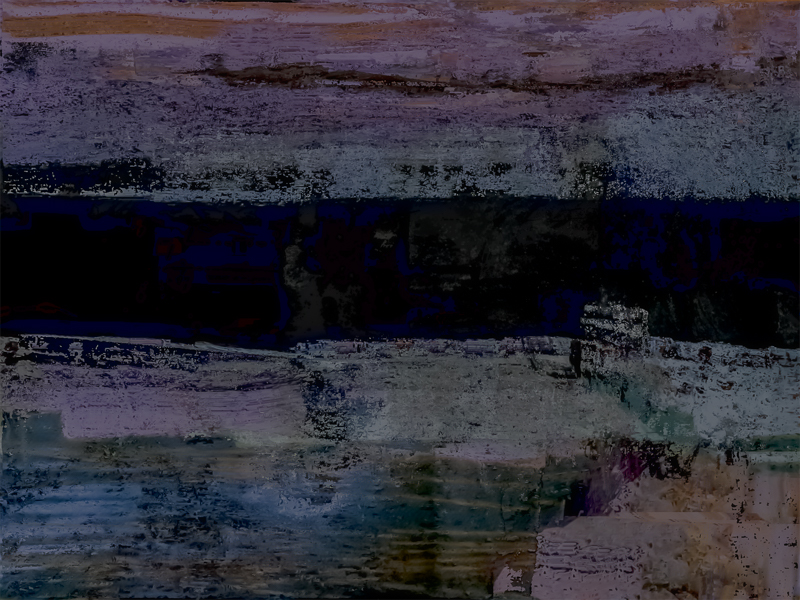
On the fourth day, as we returned from our evening sortie, I stopped. I am not sure why. Probably the evening light changed my perspective. I took the camera out and made a handful of ME burst mode exposures, moving it slowly back and forth, the kind of gesture that produces what might generously be called movement studies and what might more honestly be called ‘mush’. Then I put the camera away, stepped carefully over the grid, and walked on.
When I came to the files that evening, one of them made me sit forward. It did not look like the field. It did not look like the lochan or the cattle grid or the smear of darker grey. It looked like something half-remembered from a place I could not quite name. I kept returning to it. Not because it was resolved, but because it was not. There was something in it that kept asking me back, and that asking was the point.
This is what I has been playing on my mind ever since: the idea of staying with not-knowing, and what it costs us when we refuse.
You are all technically capable here. You can handle the camera, bend the software, manage the layering. That competence is real and hard-won, and there is nothing wrong with it. But it can bring a particular temptation: to reach, too quickly, for clarity. For legibility. For the version of the image that can be explained in a sentence. The competent hand wants to resolve. And sometimes that is exactly the wrong instinct.
The images that have lasted longest in my own practice, the ones I keep returning to across months and years, are almost never the clean ones. They are the ones where the subject is half-remembered, half-imagined. Where I cannot quite name what I am looking at. Where the image holds a question rather than offering an answer. Those are the ones that keep asking me back in. They contain doubt.
I think we need to separate intention from over-determination, because they are not the same thing and we sometimes speak as though they are.
Intention, as I understand it, is about arriving with a question. What am I drawn to here? What am I willing to risk? It is a frame held loosely, a direction rather than a destination. Over-determination is something else entirely. It is when I have already decided what the image must be before I have made it, when I am bending everything, the subject, the gesture, the processing, simply to confirm what I settled on in advance. The image becomes a vehicle for a thesis already written. It arrives pre-sealed. There is no air left in it.
Bruce Percy (who, you will be excited to hear, I am interviewing later in the summer for ARBN) has spoken about allowing the landscape to suggest the photograph rather than imposing a preconceived image onto it. I find this enormously useful, not as a general philosophy but as a practical discipline on any given day. You can arrive at a location with a loose conceptual frame, loss, perhaps, or persistence, or the feeling of something that has just passed through, without already knowing what the images must look like. The work then has the possibility of talking back to you. You are not transcribing; you are listening. I am drawn to the openness of this approach.
When intention holds space for surprise, something more porous emerges. And porousness is worth protecting.
There is a painter whose work I keep returning to when I think about this: Antoni Tàpies. A recent discovery of mine, but I think I am late to the party in this.
His surfaces are not decorative. They carry sand, marble dust, crumbled paint, scratched-back marks, layers that half-reveal and half-conceal what came before. You cannot read a Tàpies painting in the way you read a sign; the marks resist that kind of extraction. They propose. They suggest. They sometimes refuse altogether. And yet the work is never arbitrary. There is intention there, deep and serious intention, but it holds room for the material to speak, for the process to leave its own trace.
What Tàpies understood, I think, is that a surface which has been lived in is not the same as a surface which has been designed. The accumulation of decisions, the traces of earlier states, the marks that were almost erased but not quite: these are not impurities to be cleaned away. They are the record of genuine engagement. The image holds the history of its own making, and that history is part of what makes it resonant.
Frances Walker knows this too, from her end of the practice.
Her paintings and prints of the Hebrides are, in some sense, legible: headlands, water, islands, weather. But there is always something withheld. Edges dissolve into weather. Marks accumulate into dense passages that feel less like depiction and more like the memory of having stood in a place through multiple seasons, in changing light, carrying different things. What I take from Walker is the value of accumulation and erasure as a way of thinking. Her surfaces carry traces of earlier decisions, over-painted forms, ghost marks, passages scraped back, evidence of how the image became itself. The final thing is not separate from its history; it contains it.
In multiple-exposure and ICM work, we have something directly analogous. When we layer exposures that do not align neatly, we allow earlier gestures to remain visible as ghosts within the final frame. The image carries its own archaeology. Ambiguity here is not only in the subject; it is in the visibility of process. You can see, or sense, that there were earlier moments, earlier attempts, earlier ways of looking, and that they have not been tidied away.
The temptation with our tools can be to always tidy. To mask, blend, smooth, until the underlying uncertainty is invisible and the image looks decided. But what if those failed layers, those awkward overlaps, those earlier gestures that did not quite work, are integral to the meaning? What if the final image is less a window and more a record of ongoing negotiation?
There is also something worth saying about ambiguity and the world we are making photographs inside.
The culture we live in produces confident images at extraordinary volume. Advertising, propaganda, social media, they all speak in assertions. They have already decided what you should feel. They are closed, in the way I mean: pre-sealed, the air removed. To make work that refuses this register, work that does not resolve into a quick meaning, work that asks for slower, more uncertain attention, is, in itself, a kind of positioning.
But this comes with its own responsibility. Ambiguity is not automatically a virtue. The question we have to hold honestly is whether we are obscuring in order to reveal something difficult, something that clarity would flatten, or whether we are simply avoiding the work of being clear where clarity is needed. Ambiguity as evasion and ambiguity as depth look identical from the outside. Only the maker knows, or should know, which one they are standing in. And sometimes, if we are being rigorous, we have to admit that we are not entirely sure.
I think we can also learn to tune the degree of not-knowing in our work more deliberately than we sometimes do, rather than treating it as something that simply arrives by accident when the technique is messy enough.
One way is to work with subjects that are already on the edge of dissolving: reflections, weather, foliage in strong wind, shadows on water. And then to push them, deliberately, a little further past recognition than feels comfortable. Not to destroy the image, but to ask yourself, at each stage, how much the viewer actually needs in order for the image to hold. You might be surprised by how little.
Another way is to pay attention to the anchors you habitually give the viewer, and to try, in at least some work, to remove them. No horizon line. No isolated legible object. No colour that says the word forest or the word sunset before the viewer has had time to bring their own weather. These are constraints, but they are generative ones. They define a territory of uncertainty within which you can wander. They also, usefully, reveal where you tend to resolve ambiguity too soon, where your hand reaches for safety before you have asked whether safety is what the image needs.
All of this is easier to write about than to live with.
In practice, doubt shows up. Is this anything, or just a mess? (Just more ‘mush’, Chinnery?) Am I staying with something genuine, or have I simply avoided doing the work? The question comes at different points for different people. For me it often comes in the evening, looking at what I made in the morning, when the cold of the field has worn off and the slightly magical version of the day has been replaced by its more ordinary self.
I made an image some months ago as I struggled with my current project, something that felt, when I set it aside, like a failure. It had not done what I hoped. It fell short. I left it open in Photoshop and moved on. A day later I came past it, still sitting there on the screen, and something made me pause. I looked at it again. It was not, it turned out, the total loss I had decided it was. There was something in it, something lurking in the tonal relationships, something in the way the layers had disagreed with each other. Five minutes of attention, not rescue, just attention, and it had found its way into my saved collection. It is still there. I still do not entirely know what it is about. And I find I am content with that. Whether it makes the final cut is not, right now, of any importance. I am just content to cogitate on it for a while longer. I am learning up here that there really is no rush in all this.
I do not think the answer to doubt is to eliminate it. I think the answer is to learn to navigate inside it without being paralysed. This means, in practice, separating making from judging: giving yourself permission to produce unresolved work, and resisting the urge to immediately classify it as success or failure. Letting images sit. Returning to them when you are less decided about them. Looking at the rejects, periodically, not to find what went wrong but to find what is alive in them, what strange collision or accidental void might be the seed of something.
It also means noticing the language you use when you talk to yourself about your work. When you say, “This is about X,” you have already closed something. The more useful formulation is softer: “I was curious about,” or “I was testing what happens if.” Those phrases keep the image open. They leave room for it to be something else than what you decided it was.
The images I trust most, in my own practice and in the work I find myself returning to, are the ones that remain slightly out of reach. Not because they are withholding something knowable, not because they are puzzles, but because they are genuinely still asking. They hold their uncertainty the way the lochan holds the weather: not as a failure to be something else, but as a condition of their own particular life.
As you head into the next making cycle, you might carry one or two of these questions quietly with you.
Where are you trying to force your images to mean more clearly than they want to? And what would it look like, in the work, to honour the ambiguity that is already there?
Have a wonderful time making stuff everyone. relish the process.
If this is the kind of content you have been hungry for, FYV is a small community of photographers who are quietly leaving the rules behind and finding their own way into more painterly, more abstract, more personal work. We would be very glad to have you. You can find out more here and enjoy a two-week free trial period of over 500 hours of content, with no obligation to join.