
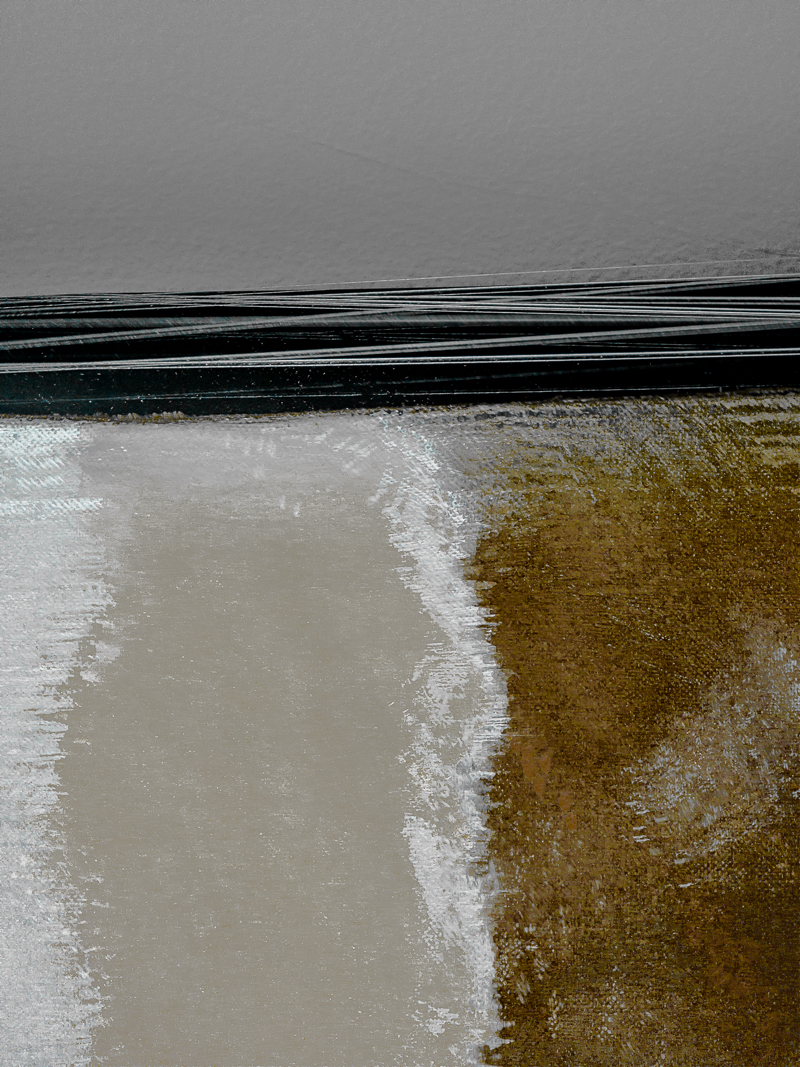
Most evenings this week, there has come a moment when the wind has lain itself down on the machair and the island has fallen quiet. The rushes stop their small tin-hiss. The washing line stops its slow drift. Eddie, always alert despite seemingly deep in sleep, lifts his head from the mat and looks at me, because he can hear what I can hear, which is nothing. A stillness so complete it is almost audible. It is the kind of stillness the guidebooks call peaceful and the ferry brochures photograph.
It is not peaceful. It is a warning.
I have lived here now for just over a year, and I have learned what a still evening on North Uist actually means. It means the wind has dropped below the threshold, five or six miles an hour, maybe less, at which the meanbh-chuileag, what the rest of the world knows as the midge, can lift herself from the peat. And once she can lift, she rises in her thousands. Then her hundreds of thousands. Then in the numbers we only ever describe in weather, a cloud, a fog, a ceò, because the language of a single fly no longer holds. She comes up out of the moor as if the moor itself has decided to breathe out, and she wants blood, and she is not fussy about whose. But mainly she seems intent on mine.
I stand at the studio door in the good light of a windless August evening and understand that the evening I would have chosen to walk out with the camera has just been taken from me. Not by rain, which I love. Not by cloud, which I love more. But by a creature roughly a millimetre long, whose Gaelic name, meanbh-chuileag, tiny fly, is one of the great pieces of Highland understatement. It sits in the same family as a wee bit of a breeze that flattens your brassicas, or a nice soft day that soaks you to the bone in three minutes.
The trap of the calm day
I want to dwell on this for a moment, because it took me a while to see it. I am not very quick on the uptake. In my first months here I read the island the way an incomer reads it, the way I used to read the mainland weather when I was still teaching from a car park in the Peak District. Back in those far off days, a calm day was a working day. A calm day was an outdoor day. A calm day was the day you loaded the pack and drove out to the shore, because the light would not be rushed off the water and the long exposures you had been waiting for became finally possible.
I know now that on North Uist a calm July or August day is very often a midge day, and a midge day is not a working day outdoors. It is a warning painted onto the atmosphere in invisible ink. The moor is telling me, in the only language the moor speaks, that if I try to go out and stand in one place for the time a picture needs, five minutes, ten, half an hour, I will not be photographing the machair. I will be photographing my own capitulation, mid-slap, mid-grumble, walking back to the pick-up with tears streaming and a red rash climbing the back of my neck, destined to scratch for days.
It has taken me some months to accept that the still evening is not the gift my mainland eye once thought it was. It is a particular kind of Hebridean event, and it belongs to the meanbh-chuileag before it belongs to me. The sensible thing is to bow to the arrangement and go and do something else.
Not stronger than the moor
There is a temptation, when a working day is taken from you, to fight for it. To stand at the window and calculate. To reach for the head net and the smidge and the trousers tucked into socks, and to try to win. To be valiant, unbowed. Manly. To walk out anyway, because you had planned to walk out. I have done all of this. It never ends well. The retreat is rather pathetic and humiliating, frankly. It ends with a picture that isn’t really about the picture. It is about my determination to make a picture on a day the island had already declined to give.
I have arrived, slowly, at a small principle that I need to admit to, even though it will sound obvious to anyone who has lived here longer than a season. I am not stronger than the moor. I am not stronger than the weather. I am not going to negotiate my way past a species that has been in these islands for as long as anyone has been here to be bitten by them, and that has already outlasted every attempt to catch, poison, trap or repel it. She rises when the wind drops. That is the deal. She is neither cruel nor thoughtful. She is meanbh-chuileag, and she is doing what a fly does with a fly’s whole life, which is to feed and to breed and to leave more of herself behind before the cold comes.
I can rage at her, or I can rearrange the working day around her. Only one of those actually has any chance of success.
What she moves me to
So I am learning to let the midge edit me.
When the wind drops and the solasbreac of a still evening comes in through the bothy door, I close the bothy door, and I go and I paint, or edit some images. Not begrudgingly. Not as a second-best, waiting for the outdoor day to return. But with something that is beginning, at last, to feel like consent. A working consent to the shape the island has offered.
The paintings that come out of these forced-in evenings have a quality I could not have got standing in a windless field slapping at my ears. They are still. Their marks are slower. Their palettes are the palettes I remember from the walk that morning, rather than the palettes in front of me, which is, I am starting to think, the palette I actually want. The remembered dath, not the observed one. The moor at one remove.
I lay out primed panels I gessoed weeks ago. I put on the BBC, Radio 4. Calm descends. Eddie takes his place on the rug near the door. Elizabeth is upstairs in the cottage at her own craft work, and the sounds of nature outside, the cries of geese on the loch, a pair of Ravens cronking overhead, keeps me company through the wall. My hand finds the carborundum plate I was going to develop next week, and I bring it forward instead. I mix a run of colours I could not have come up with an hour ago: a peat black warmed with a rust the moor has been carrying all afternoon, a bone the colour of the lower sky over Balranald, a machair straw that is really the inside of a shell more than the outside of a grass.
The midge has decided my medium for the evenings work. And I am, oddly, grateful.
The editor at the window
Here is the part I did not expect. The meanbh-chuileag is, for me, becoming a kind of editor. Not the editor with the red pencil who trims the sentence. The editor before the editor, the one who says: not this evening, this evening you make something else. She is the first cut. She removes an option before I have to.
Anyone who has tried to hold a working practice steady over years knows how tiring the option of ‘everything is possible’ becomes. On a mainland studio day I had to decide, unaided, what to do with the light I had been given. On a still North Uist evening the midge has already decided. My job is to accept the shape of the decision, walk twenty paces to a different door, and get to work.
There are worse editors. And there is a lesson in the small thing making the large decision, a lesson about scale and about who gets to shape a day, that keeps returning to me as I paint. I stood in our garden three mornings ago in the early light, looking out toward Loch Sandarraigh beyond our drystone wall, and watched a hen harrier lift over the peat and change the whole feeling of a hundred acres just by being there. Now I am watching a creature the length of a full stop rearrange a hundred acres of my working week. Both are teaching the same thing. The size of the mover is not the size of the movement. Small things move large things all the time on this island, if you are prepared to be moved.
The Gaelic word does the work
I keep returning to the Gaelic. (the seemingly impossible language I am trying very badly to learn) Meanbh-chuileag. Tiny fly. Nothing dramatic about it, nothing romantic, no exaggeration of the misery the creature actually causes. Gaelic naming, so far as I can read the little I can read of it, tends to this quiet accuracy. It is the same accuracy that gives us ceò for mist and dìle bhàite for the kind of downpour that drowns things, without any need for a Homeric adjective. The word describes what the thing is, and lets the thing be what it is.
I think this is why the language keeps drawing me. Not because it is beautiful, though it often is, but because it names things with the confidence of long acquaintance. English tries to sell you a feeling. Gaelic points at the thing. If I keep spending time with these words, carefully, as a beginner, without pretending fluency I do not have, I think my pictures might learn a little of the same discipline. Point at the thing. Do not embellish. Trust that the thing, well pointed at, will contain its own weight.
Perhaps this is one of the small gifts of the meanbh-chuileag week. She has driven me out of the outdoor sentence and into the indoor one, and in the indoor one I have had time to read for an hour before painting, and to sit with the Gaelic name and feel the fit of it.
The rhythm the island keeps
None of what I am saying is new. Anyone who has lived on North Uist, South Uist, Barra, Lewis or Harris longer than a season knows about the midges and has arranged their year around them. Peat is cut before the midge comes up in earnest, or late enough that a breeze off the Minch can be relied on. Fencing, roof work, garden work; all of it is done with an eye on the wind gauge as much as on the rain gauge. The islanders’ calendar is not the calendar of a mainland gardener. It is a calendar built around what the weather permits and what the weather actively refuses.
I am, I hope, learning to live inside that calendar rather than beside it. I no longer sulk at a windless evening. I no longer regard a meanbh-chuileag week as a lost week. I regard it as a week the island has scheduled for me, and my job is to look at the schedule, put the camera down, and find the studio door.
There is a stubborn old habit in me, an English mainland habit, that wants to make a day into what I had planned it to be. To bend a working day to my will. This place is, gently and repeatedly, curing me of that. The wind drops and the midge rises and I put down the camera and pick up a brush. I am not defeated. I am rearranged.
The still day, revisited
I want to come back to that stillness at the door.
I hear it differently now. I hear it the way I hope I might, in time, hear all the small changes on this island: not as invitations to my own plans, but as information about what the day is actually asking. A still evening in August is a meanbh-chuileag evening. A hard rattling south-westerly is a shoreline evening, when the spray stings your face and the panorama can wrap you inside the wind. A soft uisge mìn is a lochans evening, when the small waters take the drizzle and give it back as reflection. Each condition asks for a different door.
The teachers, I think, are always the small ones. The tiny fly that decides where you cannot stand. The stone lichen that decides the palette of your carborundum plate. The single feather Eddie brings home from the beach that becomes tomorrows mark making tool. I keep thinking, half-jokingly, that if I ever get around to writing a real ars poetica for this island, it will begin: do what the smallest thing tells you. The moor cannot be argued with. The sea cannot be argued with. And the meanbh-chuileag, blessedly, will not entertain your argument for a second.
Coda: the working week
For anyone keeping an odd sort of count. This week I have not photographed outdoors since last Tuesday. I have painted three panels I almost don’t hate and one I’m really quite cross with, made a small carborundum proof, badly, walked the loch walk six times, the walk Eddie loves so much because he gets to swim in four different places and got a good short set of frames that might not get deleted, and read half a book about Peter Lanyon and some wonderful Sorley Maclean poetry (in English. Sadly the original Gaelic translations which I have, are far beyond me and, I fear, always will be, but they look beautiful nonetheless, as I cast my eye across them) in the evenings while the moor gave up its warm breath and the midges rose. When the gaoth mhìn finally comes back, a soft working wind, not the kind that flattens your hair against your skull, just enough to keep the meanbh-chuileag pinned to the peat, I will be out again. Ready. And oddly rested.
I have not lost the days. The days have simply been given a different shape by a creature the size of a comma.
She is my editor this week. And I have learned, at last, not to argue with her.