
It is the fourth of July, and I could be forgiven for thinking it was the fourth of March. The rain is coming in sideways across the machair, the wind is up, and the Atlantic is doing that low grumbling thing it does when it wants you to know it is still in charge. Eddie is asleep in his basket, curled into himself the way only a dog can, oblivious to the weather and to the small crisis brewing in his human – namely, that I am on my third mug of tea and will shortly have to make the dash across the yard to the cottage. The joys of a Studio Bothy without plumbing.
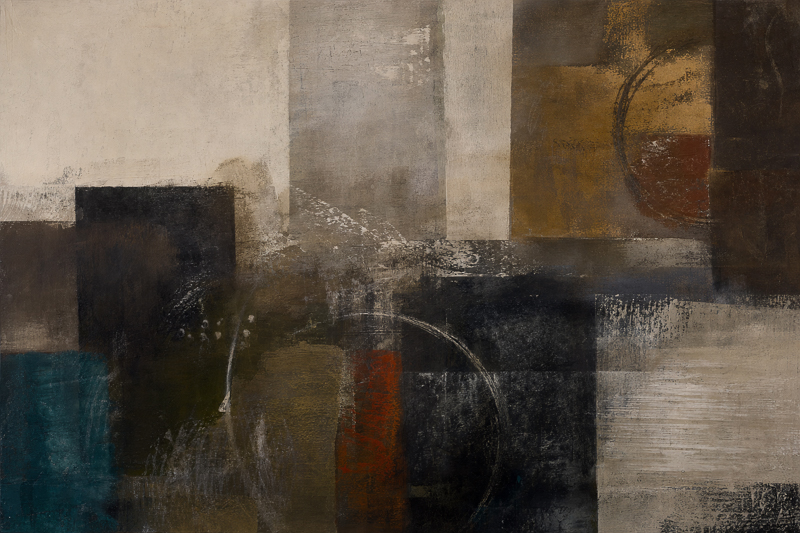
But I am happy. Deeply, quietly, undramatically happy. There is paint on my hands. There is a canvas on the easel that is starting, finally, to say something back to me. And on the Bluetooth speaker, Bob Dylan is working his way through a playlist I have curated over years – every song one I love, no filler, no polite inclusions. Visions of Johanna. Stuck Inside of Mobile With the Memphis Blues Again. Tangled Up In Blue. Positively Fourth Street. Old Bob, rasping and gnomic and full of the weather of his own long life.
I know Bob is not everyone’s cup of tea. And I know that, for some of you, music while working is unthinkable – an intrusion, a small tyranny, a set of borrowed emotions crowding out your own. I understand that. I have friends who need silence the way I need Dylan, and their reasons are as good as mine. But it set me thinking, this rain-lashed afternoon, about the rooms we build around our making. The company we keep, or refuse to keep, while the work is happening. And I thought it might be worth spending a post on it.
What music does, when it works
For me, music at the easel or the desk is not background. It is a kind of second weather in the room. It sets a tempo my hand can lean into or push against. Certain records make me looser – Radiohead, The Housemartins, I Am Kloot, The Lathums anything that lopes rather than marches. Others sharpen me – J.S. Bach on a good day, all that architecture, that faith, that structure is a form of freedom. Dylan is somewhere else entirely: he is company. A voice in the room that is not asking anything of me, but is also not pretending I am alone.
There is something in the way music occupies the front of the mind that lets the back of the mind get on with its real work. The critical, editing, second-guessing part of me – the part that ruins more paintings than any lack of skill ever has – is kept busy following a lyric, tracking a chord change, mouthing a line I know by heart. Meanwhile, the hand moves. The eye chooses. The picture makes itself, more or less, while I am usefully distracted from interfering with it.
I suspect this is why so many artists work to music, and why so many others cannot. Some of us need the front of the mind occupied so the rest can breathe. Others find that any voice at all – even a wordless one – colonises the whole room and leaves no space for their own thinking.
What silence does, when it works
I have known silence too. There are days when I put the speaker away and let the studio fill with the sound of the wind under the eaves, the rain on the roof, Eddie schnuffling in his basket as he dreams of chasing rabbits. On those days, whatever I am painting seems to need its own quiet to find itself. Music would be a hand on the shoulder when what is wanted is to be left alone.
Silence, in the Japanese aesthetic sense of Ma – the pregnant pause, the meaningful gap – is not absence. It is the room the work needs in order to speak. There are pictures I could not have made with Dylan in the corner, however much I love him. They needed the North Uist weather as their only soundtrack.
So neither music nor silence is the answer. They are different tools for different work, and part of learning our craft is learning which we need on which day, and having the discipline to reach for the right one.
The room itself
But music and silence are only the surface of it. Underneath is the deeper question of the space we make for our making.
Not everyone has a studio. Most of you, I know, do not. You have a corner of the kitchen table, a spare bedroom shared with the ironing board, a shed you have carved a working patch out of, a laptop on the sofa while the household eddies around you. When I lived at Worksop, my working space was a single small bedroom that also had to be my office. It was cramped and frustrating and, more often than I like to admit, defeating. I would set up, work for an hour, tidy everything away so I could reach the computer, set it up again the next day. The friction of it wore me down. Some days I did not paint at all because I could not face the choreography.
And yet. Work came out of that room. Not as much as I would have made with more space, and not as freely, but work nonetheless. Looking back, I think the room taught me things I would not have learned in a large studio. It taught me economy. It taught me to plan. It taught me that the space we work in is not primarily a physical thing but a mental one – a decision, renewed daily, that this is where the making happens, however small this may be.
That is why, standing now in my Studio Bothy with its whitewashed walls and its view of Loch Sandarraigh and its dreaming dog snoring gently in the corner, I try never to take it for granted. I know what its absence feels like. I know the small daily grief of not having a place to leave a wet canvas standing overnight.
Optimising what you have
If you are working in a small space, a few things I have learned, for what they are worth.
Claim it, even if it is only a corner. Put something on the wall that says this is my working place. A postcard. A print. A photograph of a painting you love. Territory is a psychological matter as much as a physical one, and the eye needs to know where the border is.
Reduce the friction between deciding to work and being able to work. That gap is where most of us lose the day. If you have to unpack a box, clear a table, and hunt for your brushes every time, you will find fewer and fewer reasons to start. Whatever you can leave out, leave out. Whatever you can pre-load, pre-load. Give tomorrow’s self the smallest possible excuse.
Protect the light. A small space with good light beats a big space with bad light every time. If you can position yourself near a window, do. If you cannot, buy a decent daylight-balanced bulb. Your eyes are your primary tool. Feed them.
Ritualise the beginning. Make a small ceremony of starting. Boil the kettle. Put the record on, or don’t. Light a candle. Whatever it is, let it be the signal to the rest of your mind that we are here now, and this is what we are doing.
And forgive the compromises. You are not failing because your studio is a corner of the spare room. Giorgio Morandi worked from his bedroom in Bologna for most of his life, painting the same handful of bottles and jars until they became a whole cosmology. Space does not make the artist. The artist makes the space.
What the studio really is
The studio, in the end, is not the room. It is the state of mind we enter when we cross into it. The Bothy is only the outward form of an inward decision: that today, for these hours, I am going to make something. Everything else – the tea, the dog, the wind, the Dylan, or the silence – is scaffolding around that decision.
Some of us build the scaffolding with music. Some with silence. Some with a particular chair, a particular smell of turps, a particular hour of the day. What matters is that we know what our own scaffolding is, that we honour it, and that we do not apologise for needing what we need.
Because the work asks a great deal of us. It asks us to sit down, day after day, and be honest about what we see and what we feel, and to translate that honestly into marks and colours and shapes. That is not a small thing. It deserves the room we can give it, however small that room may be.
The rain is still coming in sideways. Eddie has not moved. Bob is on to Shelter from the Storm, which seems appropriate. And I must, at last, make the dash across the yard.