
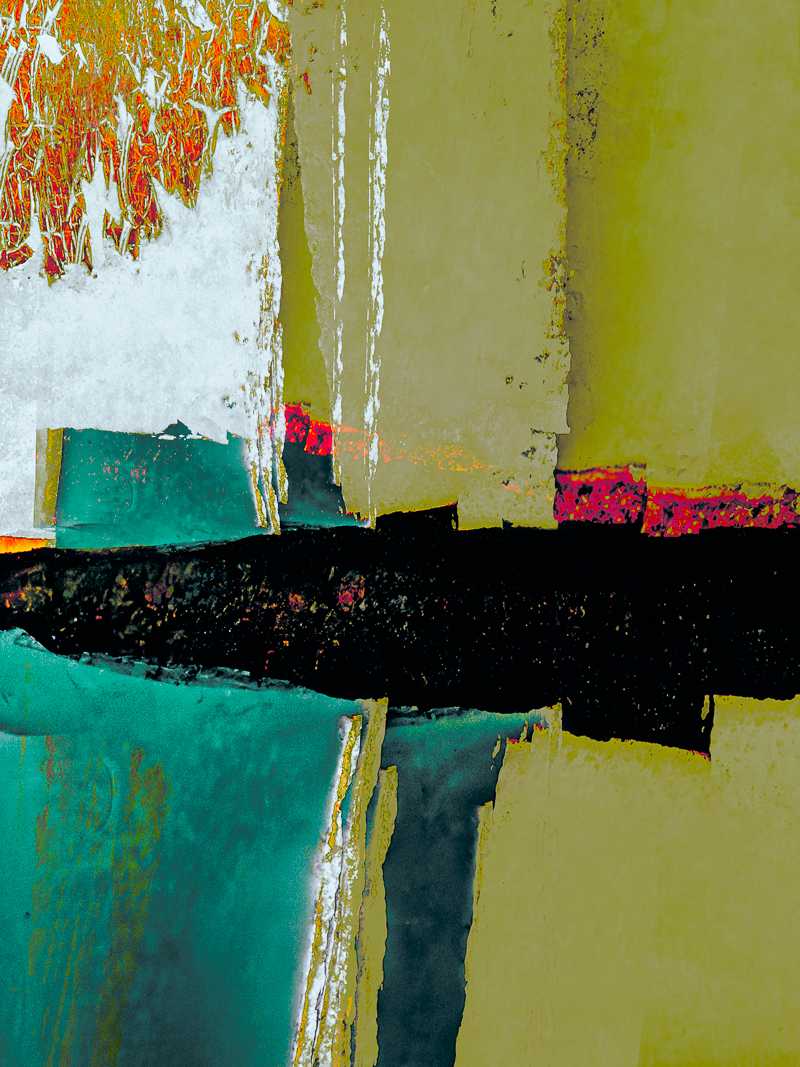
One of the first things I do in the studio these mornings is touch a painting.
Not with a brush. With the back of a knuckle, lightly, on a corner where it will not matter if I am wrong. It is a small, slightly absurd ritual, like a cook pressing the top of a loaf, and most mornings the answer is the same. Not yet. The surface gives a little. It holds the faintest print of my skin. Somewhere under the skin of the paint, the oil is still doing its slow work with the air, and there is nothing I can do to hurry it.
So I put the kettle on instead, and relish my choice of first biscuit of the day.
For years I have painted in acrylic, and acrylic taught me to be quick. You lay a colour down, you make a cup of tea, and by the time it is half sipped, the layer is ready to be painted over, scraped, glazed, or buried. The paint keeps pace with your impatience. It almost encourages it. A whole painting can be wrestled with in an afternoon, and I have lost count of the afternoons I spent doing exactly that, forcing every decision into one sitting because the material cajoled me to.
Oil will not have it.
Over these recent weeks of working with oils, I have been learning that the paint keeps its own hours. The burnt umber is dry to the touch by the next morning, brisk as a neighbour who has already been out to the sheep and is now collecting the eggs from the chickens. The titanium white takes days. It hasn’t a rush in it. The alizarin crimson sulks for the best part of a fortnight. Ivory black is slower still, if you can believe it possible. Each pigment has a temperament, and the painting is only ever as ready as its slowest passage. I can scumble a lean grey over a sky on Monday and find, on Thursday, that it is still not willing to take the next layer.
There is a rule for this, one of the oldest in the trade: ‘Fat over lean’. The lower layers are kept thin, lean in oil, and each layer above carries a little more richness than the one beneath. Paint it the other way round, rich and slow-drying underneath, lean and quick on top, and the upper skin dries first, then cracks as the softer paint below continues to move. The rule is chemistry, but it reads like a moral. Begin plainly. Let the early work be thin and honest. Save the richness for later, when there is something solid underneath to hold it.
I keep thinking about that.
The shelf of half-finished things
Because the paint will not be rushed, I have stopped asking any single painting to carry the day as I often did when fumbling around with acrylics.
Instead there are two drying racks now (one suspended from the ceiling festooned with half a dozen sock hangers, of all things, each bedecked with twenty or more small paintings), and a shelf of many small things: half-A4 sheets of oil paper, a plethora of eight by eight inch cradle panels, a pile of boards in various sizes with nothing more than a toned ground on them. Each is at a different stage. One has its first lean blocking-in, the hill and the water and the sky reduced to three or four planes. Some have been sanded back after passages I did not believe, or to reveal something of what lay beneath. Some have glazes of Payne’s grey and yellow ochre drying over fields of ochre that went too warm. Many (more than I would like to admit to) are waiting for a decision I have not yet made.
Each morning I go along the shelf and the racks like someone checking the hens. This one is ready. This one is not. This one, I realise, I have been avoiding because I am frightened of spoiling it, and that is usually the one that needs me most. The process ends with my knuckles decorated in paint.
It is a different way of working, and I am slow to trust it. The old habit was to finish something, to arrive at an image in one push and feel the small hit of completion. The rotation gives me something quieter in exchange. When I come back to a painting after four or five days, I see it with eyes that have been elsewhere. The colour that seemed so certain on Monday looks timid by Friday. The awkward edge I fretted over has settled into the right kind of awkwardness. I am less its author, for a moment, and more its first viewer. Distance is not something I can manufacture on demand, but the drying time gives it to me for nothing.
If you are a painter who works quickly, and many of you reading this are (I was), I would recommend trying this for a month. Keep six or eight small pieces moving at once – indeed, more if you can bear it- and give yourself permission to do nothing to any of them on a given day. Let the paint tell you which one is ready. You may find, as I have, that the waiting is not empty. Something is going on in it.
Island time
None of this would have landed so deeply, I think, anywhere else.
North Uist has its own version of fat over lean. Things happen in their order, and the order is not yours. The ferry from Lochmaddy sails, or it does not, depending on a wind you can hear in the chimney long before the cancellation notice arrives on your phone. The parcel you were promised on Tuesday comes on Friday, or the Tuesday after. Maybe. The man who is going to look at the roof will come when the weather and his other jobs allow, and when he does come he will want a cup of tea and a proper conversation before he goes up the ladder, and he will be right to.
When we first arrived, this drove a part of me quietly mad. I had come from a life of schedules and next-day delivery, of the assumption that if you want something enough and pay for it promptly, it arrives. It took me most of this past year to notice that the island was not being inefficient. It was being honest. The sea is real here. The wind is real. Distance is real. Everything that comes to the island crosses water, and water has its own opinion about the matter. It was me who needed to change. To adopt this new rhythm. And I find now it really suits me.
There is a Gaelic word for patience, foighidinn. I am still learning to say it properly, and I suspect I am still learning what it means. Currently, it sounds more like I am clearing my throat than speaking like a fluent native. It does not feel, here, like the brittle patience of someone drumming their fingers in a queue. It is closer to the patience of a crofter waiting for the ground to dry before it can be worked, or of anyone who has lived long enough beside the tide to stop arguing with it.
Out at Vally, you cross the strand when the sea has gone out, not before. Walk it at the wrong hour, and the sand is a sheet of moving water, and the island beyond it might as well be in Norway. Walk it at the right hour, and there it is: a broad, ribbed floor of wet sand, pools holding fragments of sky, the light lying flat and silver across the whole of it, and Eddie running ahead in wide, delighted loops as though the sea had drawn back purely for him. The same place, entirely changed, depending only on whether you were willing to wait.
I think about that walk a great deal when I am standing in front of a painting that is not yet dry.
October
It is October now, and the island is changing gear.
The light comes in lower each week, longer and more sideways, raking across the machair so that every tussock casts a small shadow and the ground looks combed. The colours are draining towards the palette I have been trying to mix all month: wet bronze in the grasses, a bruised violet on the hills towards Eaval, lochans gone to pewter under heavy cloud, then, for ten minutes, a shaft of sun that turns everything to brass and is gone before I can lift the camera. The geese are coming in. I hear them before I see them, a ragged conversation overhead, and then the long uneven lines of them drawn across a grey sky like something written in a hurry.
Eddie and I walk most mornings, whatever the weather is doing. He does not care about the light. He cares about the smell of whatever has crossed the track in the night, and about the precise point at which the walk becomes a run. I have come to rely on him for this. He has no interest in whether I feel productive. He wants to go out, and so we go, and very often the day’s first useful thought arrives somewhere between the second gate and the shore, when I have stopped trying to have one.
The weather here does not care about your plans either. You can set out under a clean sky and be walking home inside a squall of horizontal rain twenty minutes later, hood up, glasses useless, the world reduced to a grey blur and the sound of water on fabric. Then it passes. It always passes. And what comes after, that rinsed, glittering clarity, with every fence post sharp and the sea suddenly a colour you have no name for, is only available to those who were willing to stand in the rain first.
The camera, slowed
I have been trying to carry this into my photography, and it has been harder than I expected.
The camera is a machine built for impatience. It was invented, in a sense, to stop time, to grab the instant before it goes. And the digital camera has made that grabbing nearly free. I can make three hundred frames on a morning walk and look at none of them properly. For years, if I am honest, that is how I often worked: shoot widely, hope generously, and sort it out later at the screen.
So I have been trying a few small disciplines.
The first is to go back to the same places. Not new places, not the dramatic places, but the same stretch of shore, the same lochan, the same fence line running into the bog, again and again across the weeks. The first visits produce the obvious pictures, the ones the place offers to anyone. It is only on the fifth or sixth return, when I have stopped expecting anything, that the place starts to offer something less obvious: a particular grey that only happens when the cloud is at a certain height, a rhythm in the reeds that only shows itself when the wind comes from the west, a way the water and sky dissolve into each other on still afternoons that I would never have seen had I not been bored enough to keep standing there.
The second is to make fewer frames. When I am working with camera movement or multiple exposures, it is easy to treat each frame as a lottery ticket. Lately I have been trying to make each one count, to wait until the light, the gesture, and my own attention line up, and only then press the shutter. Some mornings I come home with a dozen frames. Some mornings I come home with none, and that has turned out to be fine. The walk was not wasted. The looking still happened.
The third, and hardest, is to leave the images alone. I have started letting a week or more go by before I edit anything. It is astonishing how different a photograph looks after seven days. The one I was sure was the picture of the morning often turns out to be a pleasant echo of something I have seen before. The one I nearly deleted, the awkward, overexposed thing with the horizon in the wrong place, sometimes turns out to be the only frame with any life in it. The excitement of the moment is a poor judge. Distance, again, is the better one, and the only way to get it is to wait.
It is the knuckle on the painting all over again. Not yet. Not yet. Now.
Lean first drafts
Writing has been slower to learn the lesson, because writing is the place where my impatience hides best.
I am working on a book, as some of you know (a pipe dream, I think, but I wrestle with the words nonetheless), and the temptation with a book is to try to write the finished sentence the first time: rich, weighty, every clause loaded with meaning. It does not work. Or rather, it works for a paragraph, and then the whole thing seizes up under its own importance. Those sentences are the fat laid down too early. They look wonderful wet, and then they crack.
So I am trying to write lean. The first draft of a chapter now is thin, plain, almost embarrassing: what I saw, what I think it means, what I am not sure about. No flourishes. No attempt to sound like a writer. Then I leave it. A week, a fortnight sometimes. When I return, there is something solid to build on, and the richer the layers, the image, the cadence, the right word, can go on top without sliding off. This post began that way: a few notes in pencil at the kitchen table, about knuckles and drying times and the ferry, left to sit until I could see what they were trying to be.
Poems are different. They come when they come, often on the walk, often in fragments that make no sense until I have carried them around for a while. A phrase about the sand at Vallay has been in my notebook for three weeks now. It has not yet found the rest of itself. I have learnt not to force it. If it is a real line, it will still be there. If it is not, it will quietly fall away, and that is a kind of editing too.
What the work yields
The deepest version of this, and the one I am least good at, has to do with expectation.
I have spent a long time measuring creative days by their yield. How many paintings finished. How many photographs worth keeping. How many words. How many people read the post, liked the image, came to the workshop. Some of that counting is necessary, because I make my living from this. But most of it, I have come to suspect, is just impatience dressed up as diligence. It is a way of demanding that the day justify itself before it has finished.
The garden has been trying to tell me otherwise all year. Anyone who grows vegetables on an island in the Atlantic learns quickly that the harvest is not a reward for effort. It is a negotiation with wind, salt, soil, slugs, and a growing season that arrives late and leaves early. You do the work, and then you wait, and some years the waiting is generous, and some years it is not. What you cannot do is stand over the bed and demand the carrots hurry up.
The paintings are the same. Many of the small pieces on that shelf will not become anything I would show anyone. Some will be scraped back to the ground and begun again. A few, perhaps, will become the quiet foundations of better paintings I cannot yet see. Their yield is not in them. It is in what they are teaching my hand, my eye, and my judgement, slowly, layer by layer, in a way no single afternoon could. Even a fully dry oil painting is not truly finished. The paint goes on curing underneath for months, sometimes for a year or more, before it is ready to be varnished. There is always something still happening below the surface.
I find that strangely consoling. It suggests that the work of a day does not end when the day does. That a morning in front of a stubborn painting, or a walk that produced no photographs, or a page of writing I will eventually cut, may still be curing somewhere, hardening into something I will one day stand on.
Evening
The light goes early now. By late afternoon the studio window holds a long band of pale lemon over the hill, fading through grey into the first blue of evening, and the paintings on the shelf lose their colour one by one; the warm ones last.
Before I switch off the lamp, I touch the corner of the painting again. The burnt umber passage is dry. The white is still soft. The alizarin is sulking, as expected.
Tomorrow, perhaps.
Eddie is at the door, making his views known about supper. The kettle is going on again. Outside, the wind has dropped, and over towards the sound the sea is doing what it does twice a day, every day, without hurry and without fail: going out, coming back, going out again.
There is time. That is the thing the island keeps telling me, and the paint keeps telling me, and I am, very slowly, beginning to believe it.